Source: Civitatis · checked on 19 October 2026. Subject to change. Affiliate link.
START HERE
Valencia isn't a checklist. Discover it.
The essentials in Valencia are the City of Arts and Sciences, La Lonja de la Seda, the cathedral and the Mercado Central. The market, the Turia Gardens and the Cabanyal streets are free. Book the Oceanogràfic or a guided visit ahead; La Lonja and the cathedral you can buy on the day.
Valencia is easier to plan than most big Spanish cities, because very little here needs a reservation. The old center is compact: a 15th-century silk exchange, a cathedral that shows a chalice venerated as the Holy Grail, and a covered market all sit within a few minutes of each other. A half day is enough for all three, and none of them needs a reservation.
The second half of the city is the Turia Gardens. After a flood in 1957 the river was diverted, and its empty bed became a long, flat park that leads straight to the white buildings of the City of Arts and Sciences. You can walk or cycle the whole route in one go. Then take a tram to El Cabanyal for the sea and a rice lunch, since Valencia is where paella comes from.
Bella Visita editorial team · Sources and editorial guidance: 19 October 2026
THE BEAUTY, ONE PLACE AT A TIME
What's worth the visit.
6 selected places
01 Ticket neededBetter to book ahead
City of Arts and Sciences
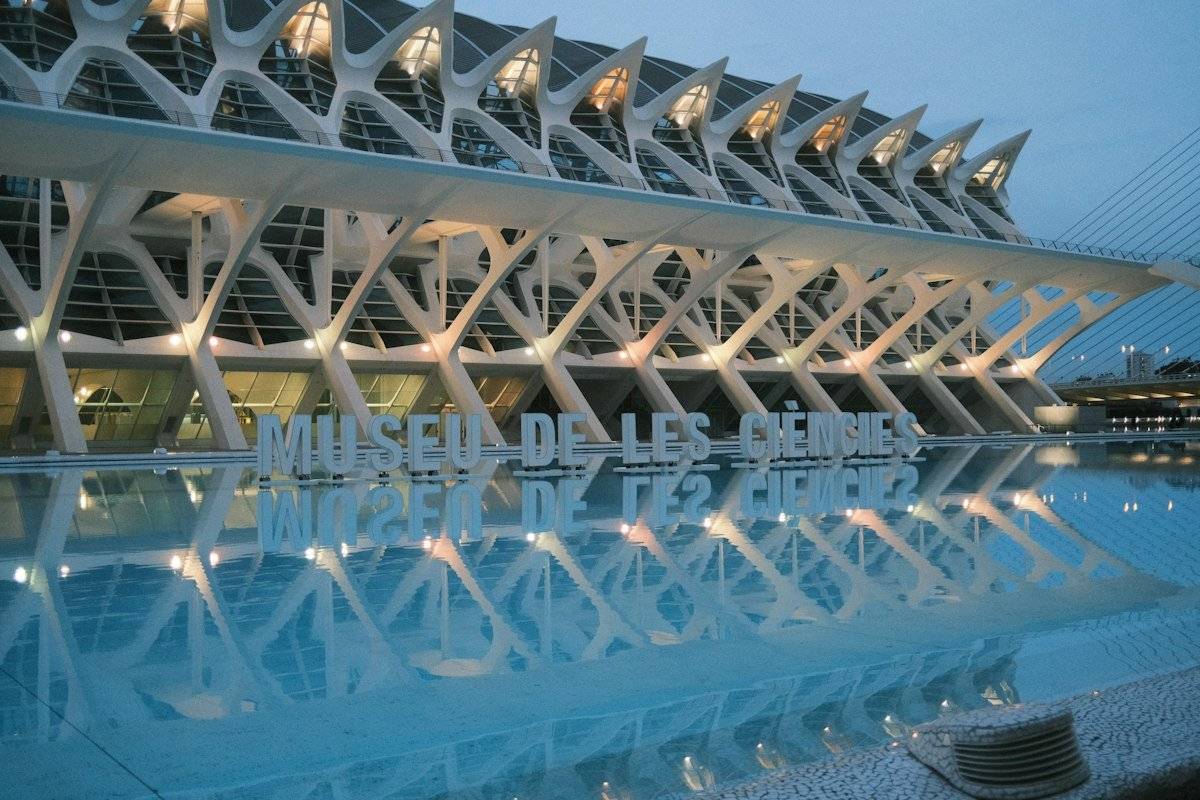
A white complex by Calatrava and Candela: opera house, science museum, aquarium. Walk it free; pay only for what you enter.
The exteriors are free to walk, and the pools, arches and bridges are the main reason to come. Inside, the Oceanogràfic aquarium, the Science Museum and the Hemisfèric are separate tickets, so decide which one you want before you buy. Families usually pick the Oceanogràfic. With one free afternoon, walking the site and entering a single building is enough. Check the official site for combined options and for what is open on your date.
The choice, in practice. Go in the late afternoon, when the light is softer and the white surfaces reflect in the water.
A late Gothic silk exchange from the 15th century, on the UNESCO list. Small fee, free on Sundays.
The Sala de Contratación is the reason to go: slender twisted columns rise into a vaulted ceiling and look like palm trunks. Merchants traded silk here when Valencia was a major Mediterranean port. A courtyard with orange trees sits beside the hall. The visit is short and fits easily before lunch. There is a small entry fee and no need to book.
The choice, in practice. Sunday entry is free, which also means a queue. Go early or pick another day.
A cathedral built over several centuries, with a cup venerated as the Holy Grail and a bell tower you can climb.
Construction began in the 13th century, and Romanesque, Gothic, Baroque and Neoclassical parts sit on top of each other. The chapel of the Holy Grail holds an agate cup that the church venerates as the chalice of the Last Supper. Historians treat the claim with caution, but the chapel is the main draw. The Miguelete bell tower next to the cathedral gives a view over the rooftops of the old center.
The choice, in practice. Check on the official site whether the tower climb is included in your ticket.
A modernista iron-and-glass hall of fish, produce and cured ham stalls. Free to walk through.
The building opened in 1928 and counts among the larger fresh-food markets in Europe. Look up at the stained glass and the ceramic details of the dome, then follow the produce stalls toward the fish section at the back. Stallholders sell by weight to locals, so it works better for buying fruit, almonds or cheese than for a sit-down meal. It faces La Lonja, which makes the two an easy pair.
The choice, in practice. Come before lunch. Stock is fullest and the stalls are busiest earlier in the day.
A former riverbed turned into a park through the city. Free, flat and good for walking or cycling.
After the 1957 flood the Turia was rerouted south of the city, and the dry riverbed became a continuous park of lawns, playgrounds, sports fields and orange groves. It runs for roughly nine kilometers, passes under old stone bridges and ends at the City of Arts and Sciences. Walking or cycling it is the easiest way to link the old center with the modern buildings. Bikes are easy to rent around the old town.
The choice, in practice. Cycle it from the old center toward the City of Arts and Sciences. The route is flat the whole way.
A former fishing quarter with tiled facades, a few blocks from the city beach. Free to walk.
El Cabanyal grew as a fishing village by the sea. It still has low houses with ceramic-tiled fronts, a style common in this quarter. A short walk brings you to the wide, flat sands of Las Arenas and Malvarrosa, and the seafront promenade has paella restaurants. Trams and the metro run from the center, so you can go for lunch and be back in the old town by the afternoon.
The choice, in practice. Order paella at lunch and share it. Most kitchens cook it for two or more people.
Not just monuments. Three ways into its character.
01 / ANOTHER VIEW
El Carmen
The oldest part of the old town, with narrow lanes, street art and two medieval gates, the Serranos and Quart towers. It is quiet by day and busy with bars in the evening. Walk it without a route; the surprises are the small squares.
A neighborhood just south of the old center, full of independent cafés, small galleries, restaurants and food shops. It has few monuments, so treat it as a place to eat, have a long coffee or spend an evening between sights rather than as a sightseeing stop.
The old seafront quarter, a short tram or metro ride from the center. Tiled fronts, small streets and the beach promenade make it a good half day away from the monuments, and the right area for a seafood or rice lunch.
Mercado Central, Turia Gardens, El Cabanyal and the beach. Walks don't include the interiors of attractions.
Choose your entry.
City of Arts and Sciences, La Lonja de la Seda, Valencia Cathedral and the Holy Grail chapel. Check the date, the time and the areas included in the option you choose.
Give places context.
A guide can make the difference if you want to connect what you see to history. Compare language and inclusions before booking.
A detail that helps. Book the Oceanogràfic ahead if you want to enter it. For La Lonja, the cathedral and the market you can turn up.
Split the city into two halves: old center on one day, Turia Gardens and the City of Arts and Sciences on another.
Summer is hot. Do the Turia ride in the morning or evening, and keep the cathedral or La Lonja for midday.
The center is flat and compact, so you can walk between most sights. Use the tram or metro for El Cabanyal.
QUESTIONS TO ASK FIRST
Inside Valencia, with a clear head.
What should I book in advance in Valencia?+
Book the Oceanogràfic and any guided visit before you travel, especially in school holidays. La Lonja, the cathedral and the Mercado Central do not need a reservation. If you want the Science Museum or Hemisfèric as well, look at the combined options on the official City of Arts and Sciences site.
Can I visit the City of Arts and Sciences without a guide?+
Yes. Walking the exteriors is free and needs no guide, and the buildings have their own signs and audio options. If you want context on the architecture, tours in English are available through the Civitatis listings below, with a guide who explains the buildings and the history of the riverbed.
Is La Lonja de la Seda free?+
La Lonja charges a small entry fee on most days and is free on Sundays. Sunday is the more crowded day, so arrive early if you plan to go then. It is a short visit, usually under an hour, and there is no need to reserve a time.
How do I get from the old center to the City of Arts and Sciences?+
On foot or by bike through the Turia Gardens: roughly 30 to 40 minutes of flat walking from the cathedral area. You can also take a city bus or a taxi. Most people walk one way for the park and ride back.
CURIOSITY DESERVES CLEAR SOURCES
Where the information comes from.
Each place links to its own source. The text separates editorial guidance from conditions to reconfirm for your date.