Source: Civitatis · checked on 19 October 2026. Subject to change. Affiliate link.
START HERE
Kraków isn't a checklist. Discover it.
The essentials in Kraków are the Main Market Square, St Mary's Basilica, Wawel Castle, Kazimierz and the Wieliczka Salt Mine. Wawel, Schindler's Factory and Wieliczka are worth booking ahead. The Main Square, Kazimierz and the Planty park ring are free to walk, and St Mary's charges a small fee.
Kraków's old town is compact, so most of the city can be covered on foot. The Main Market Square, the Planty park ring and the lanes around them cost nothing. Tickets matter at four places: St Mary's Basilica, which has a small fee, Wawel Castle, with several separate exhibitions and daily limits, the Schindler's Factory museum, with timed entry that sells out in high season, and the Wieliczka Salt Mine, which is visited only on a guided tour in set languages and times.
Kazimierz and Podgórze carry the city's Jewish history, and a guide helps with the context. These are sensitive places of memory, so allow time and do not treat them as a checklist. A guide helps in both districts. Wieliczka is about 15 km outside the city and needs a half day. Auschwitz-Birkenau has its own guide on this site and is a separate full-day trip.
Bella Visita editorial team · Sources and editorial guidance: 19 October 2026
THE BEAUTY, ONE PLACE AT A TIME
What's worth the visit.
8 selected places
01 Free access
Main Market Square (Rynek Główny)
One of Europe's largest medieval squares, with the Cloth Hall and St Mary's. Free to walk.
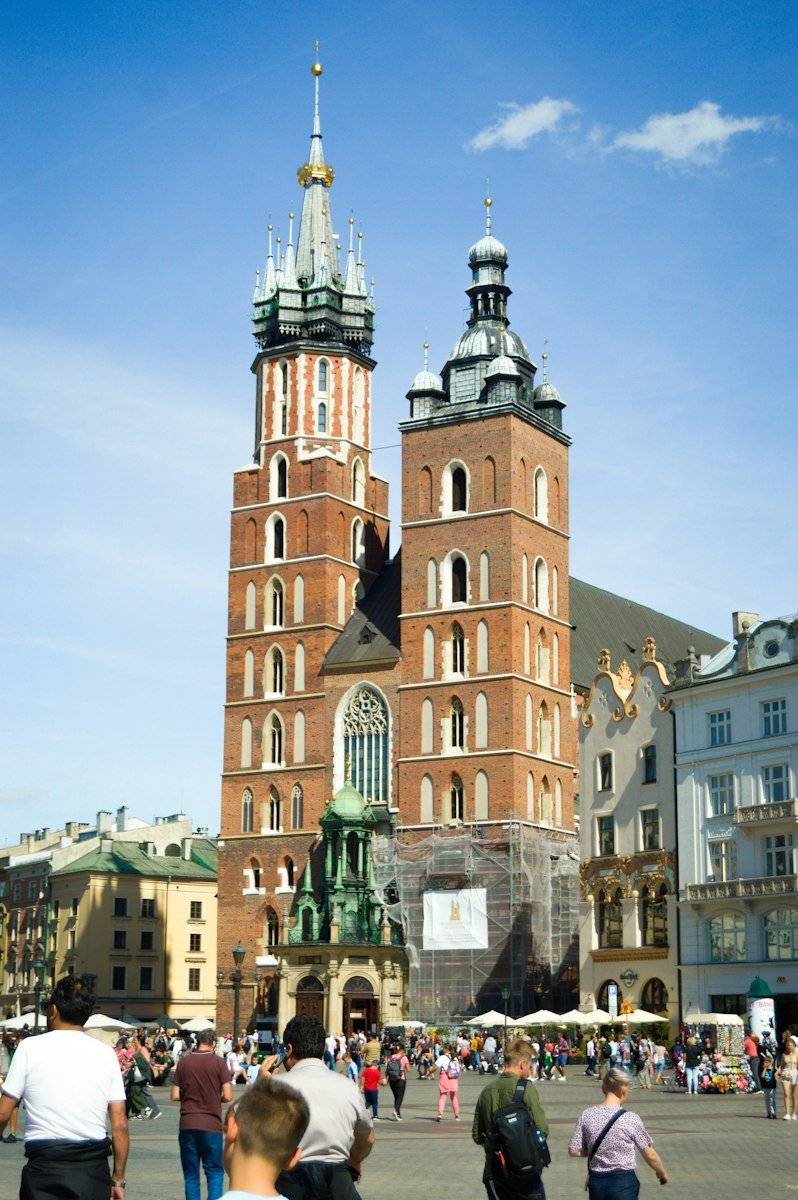
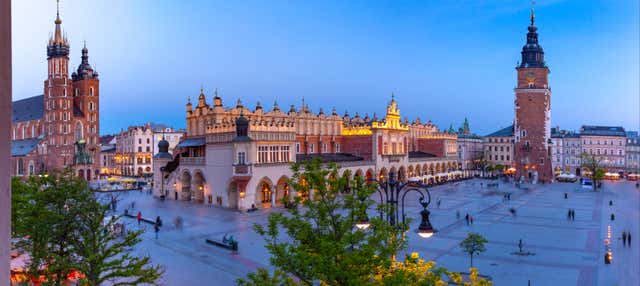
Rynek Główny is one of the largest medieval squares in Europe, and its scale becomes clear as you cross it. The Cloth Hall stands in the middle with its arcades and stalls, the Town Hall Tower rises on one side, and St Mary's Basilica sits on the corner. The square is free and busy, with cafes under the arcades. Come back after dark, when the buildings are lit and the crowds thin.
The choice, in practice. Cross the square slowly. The best views come from the edges, not the middle.
A Gothic church with a carved altarpiece and a blue star-spangled ceiling. A small fee for tourists; the bugle call outside is free.
St Mary's has two unequal towers and a famous interior. The late-Gothic wooden altarpiece by Veit Stoss is the main treasure, and the ceiling is painted blue with gold stars. A small fee applies for tourists. Every hour a trumpeter plays the hejnał from the taller tower, a short melody that stops mid-note. It is free to hear from the square, so you can enjoy it without a ticket.
The choice, in practice. Stand in the square on the hour to hear the bugle call, even if you skip the interior.
The royal hill above the Vistula. Each exhibition has its own ticket, and there are daily limits.
Wawel Hill was the seat of Polish kings for centuries. The cathedral holds royal tombs and the Sigismund Bell, and the castle contains state rooms and treasuries. Each exhibition has its own ticket and daily limits apply, so choose what you want to see before you go. Booking ahead is advised, especially for the most popular rooms. The grounds are free to wander, and the view over the river is worth the walk up.
The choice, in practice. Decide which exhibitions matter to you, then book those first.
The historic Jewish district, now mixed. A guide gives the history the context it deserves.
Kazimierz was a separate town and, for centuries, the home of Kraków's Jewish community. Before the Second World War it was a large part of the city's life. Synagogues, old cemeteries and small squares remain, among cafes and galleries. A guide can explain what happened here and why places such as Szeroka Street matter. Walk with care, speak quietly in the cemeteries and treat the district as a place of memory.
The choice, in practice. Take a guided walk if you want the history. The streets are free, but the context needs a person.
A museum in the former factory, about Kraków under German occupation, 1939-1945. Timed entry; sells out in high season.
The museum fills the former administrative building of Oskar Schindler's enamel factory, in the district of Podgórze. Its permanent exhibition tells the story of Kraków under Nazi occupation between 1939 and 1945, with the factory's own story set inside that wider history. Entry is timed and sells out in high season, so book ahead. The tone is sober, and the visit needs time and quiet.
The choice, in practice. Book early in busy months. The museum is not a spur-of-the-moment visit.
A UNESCO-listed salt mine about 15 km from Kraków. Guided visits only, in set languages and times.
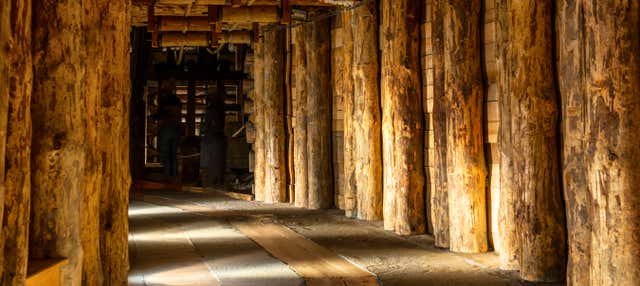
Wieliczka is a salt mine about 15 km southeast of Kraków, worked for centuries and now a UNESCO site. A guide leads you down a long staircase past tunnels, timber supports and carved salt figures to an underground chapel with chandeliers made of salt crystals. Visits are guided only, in set languages and at set times, so check the language before you book. The mine is cool, so bring a layer.
The choice, in practice. Reserve the language you need. Tours in your language run at set times only.
A memorial on the site of the former camp, in Oświęcim. Entry is free, but a pass for a set time must be reserved.
The Memorial stands on the site of the German Nazi concentration and extermination camp, about 70 km from Kraków. Entry is free, and you need a pass for a specific time reserved on the Memorial's official site. Visits with an educator are paid, and the Memorial advises against bringing children under 14 (visit.auschwitz.org, checked 19 October 2026). Plan most of a day, and read our guide before choosing between a guided trip and going on your own.
The choice, in practice. Reserve the pass first, then pick the transport. Rules can change, so read the Memorial's guidance for your date.
A green ring around the old town on the line of the former walls. Free.
The Planty is a belt of gardens and tree-lined paths that circles the old town, laid out on the site of the medieval walls and moat. It is free and open to everyone, and it is the easiest way to walk around the centre. Benches, fountains and monuments dot the route, and parts of the old defences such as the Barbican and Florian Gate still stand at the northern end. Locals use it as a shortcut and a place to rest.
The choice, in practice. Walk part of the ring between two sights instead of crossing the busy streets.
Not just monuments. Three ways into its character.
01 / ANOTHER VIEW
Kazimierz
The old Jewish quarter south of the old town, now with cafes, galleries and synagogues. It carries a heavy history, and the district is best visited with attention and respect. A guide adds context to the squares and the cemeteries.
The district across the Vistula, where the ghetto was set up in 1941. Ghetto Heroes Square, with its empty chairs, and the Schindler's Factory museum are here. It is a quiet and serious area, and not a place for a quick stop.
A residential area just north of the old town, known for its old market, Stary Kleparz, where locals buy fruit and vegetables. It shows daily life in Kraków rather than the sights. Walk through on your way to or from Florian Gate, and stop at the market if you are hungry.
Main Market Square (Rynek Główny), Planty park ring. Walks don't include the interiors of attractions.
Choose your entry.
St Mary's Basilica, Wawel Royal Castle and Cathedral, Oskar Schindler's Enamel Factory (museum), Wieliczka Salt Mine, Auschwitz-Birkenau Memorial and Museum. Check the date, the time and the areas included in the option you choose.
Give places context.
Kazimierz. A guide can make the difference if you want to connect what you see to history. Compare language and inclusions before booking.
A detail that helps. Book Wawel, the Schindler's Factory museum and Wieliczka before you arrive. Entry is timed or limited at all three.
Check the language of the Wieliczka tour carefully. Visits are guided only, in set languages and times.
Allow time and quiet for Kazimierz and Podgórze. They are places of memory, not a checklist.
Plan Auschwitz-Birkenau as its own full-day trip. Read the dedicated guide on this site first.
QUESTIONS TO ASK FIRST
Inside Kraków, with a clear head.
What should I book in advance in Kraków?+
Book Wawel Royal Castle, the Schindler's Factory museum and the Wieliczka Salt Mine. Wawel has daily limits, the museum sells out in high season, and Wieliczka runs guided visits only. The Main Square, Kazimierz and the Planty are free to walk.
Can I visit Wieliczka without a guide?+
No. Wieliczka Salt Mine is visited on guided tours only, in set languages and at set times. Check that your language is offered for your date, and book a slot before you go. It is about 15 km from Kraków.
Is St Mary's Basilica free?+
Tourists pay a small fee to enter the basilica. The hourly bugle call, the hejnał, is free to hear from the Main Market Square. You can enjoy the sound and the view of the towers without a ticket.
Is there a guide in English for Kazimierz?+
Yes, guided walks of Kazimierz and the nearby Podgórze run in English and other languages. Check the language and meeting point on each listing. A guide helps with the history. Walking the streets alone is free.
Can I do Auschwitz as a day trip from Kraków?+
Yes. The Memorial is in Oświęcim, roughly 70 km from the city, and most people go for most of a day. It has its own guide on this site with the practical rules. Check the Memorial's own website for the date you want.
CURIOSITY DESERVES CLEAR SOURCES
Where the information comes from.
Each place links to its own source. The text separates editorial guidance from conditions to reconfirm for your date.